
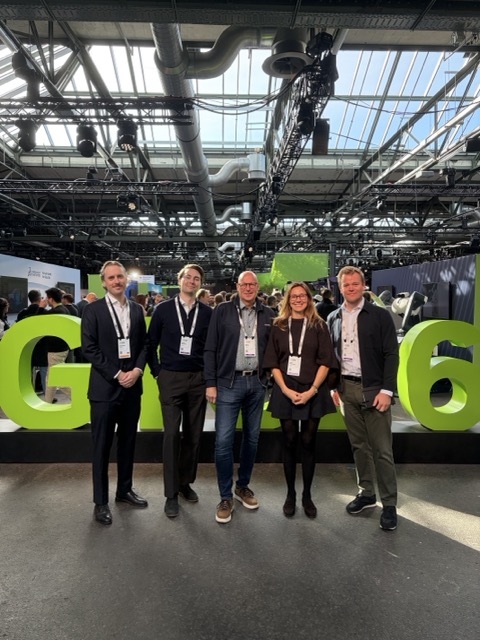
NVIDIA GTC Berlin 2026 brought together industry leaders, technology providers and innovators to discuss the rapid development of AI and the infrastructure required to support it. With a significantly larger event than last year’s European edition in Paris, it was clear that the conversation around AI infrastructure in Europe continues to gain momentum.
For Conapto, attending the event provided valuable insights into the technologies shaping the next generation of data centers and the challenges Europe faces in scaling its own AI capabilities.
Europe’s AI ambitions and the need for infrastructure
One of the recurring themes throughout the event was Europe’s ambition to become more self-sufficient in AI and computing capacity. As demand for AI continues to accelerate, access to reliable power, high-performance computing and scalable data center infrastructure is becoming increasingly important. Strengthening Europe’s position requires not only investments in computing technology, but also the ability to deploy and operate infrastructure efficiently.
For data center operators, this creates both opportunities and challenges, particularly around power availability, cooling technologies and time to market.
Vera Rubin – A new generation of computing power
NVIDIA CEO Jensen Huang presented several developments that highlight how quickly AI technology and infrastructure requirements are evolving.
NVIDIA confirmed that its next-generation Vera Rubin platform is in full production. According to NVIDIA, each GPU delivers 20 petaflops of performance, with a 72-GPU configuration reaching 1.44 exaflops of aggregate performance. Jensen Huang also highlighted performance improvements of up to 30 times compared with Blackwell for specific AI workloads.
These developments illustrate the rapid evolution of AI computing and the increasing demands placed on data center infrastructure, particularly in terms of power density, cooling and scalability.
DSX POD – Accelerating AI data center deployment
One of the most significant announcements was NVIDIA’s introduction of DSX POD, a modular, factory-integrated solution built around the Vera Rubin NVL72 platform. By assembling, integrating and testing infrastructure before delivery, NVIDIA aims to significantly reduce deployment times. According to NVIDIA, DSX POD could shorten on-site deployment from approximately six months to as little as 14 days, once the necessary site infrastructure is in place.
This approach reflects a broader industry shift towards modular construction and prefabrication, enabling operators to bring AI computing capacity online faster and more efficiently.
Spectrum-X – Advancing data center networking
NVIDIA also highlighted advancements in its Spectrum-X networking technology, now in volume production with co-packaged optics developed in collaboration with TSMC. The technology supports 512 ports at 200 Gbps, addressing the growing need for high-bandwidth, high-performance connectivity between AI computing systems. As AI workloads become increasingly demanding, networking performance will remain an essential part of delivering efficient and scalable infrastructure.
What this means for Conapto
The discussions at NVIDIA GTC Berlin reinforce several developments already shaping Conapto’s approach to data center design and operations. As computing densities continue to increase, data centers must be designed to accommodate evolving cooling requirements, high-performance hardware and rapidly changing customer demands. At Conapto, our AI-ready data centers are designed to support high-density computing environments, with air cooling for racks up to 40 kW and liquid cooling solutions for densities exceeding 100 kW per rack. Our approach combines scalability and flexibility with a strong focus on energy efficiency, heat reuse and reliable operations. The growing interest in modular and factory-integrated solutions also highlights the importance of efficient deployment and future-proof infrastructure as AI computing requirements continue to evolve.
NVIDIA GTC Berlin highlighted both the pace of technological innovation and the importance of building the infrastructure needed to support it. For Europe, the challenge is not only developing advanced AI technologies, but also ensuring sufficient computing capacity, reliable energy supply and efficient data center infrastructure.
At Conapto, we look forward to continuing to support this development through reliable, scalable and sustainable data center solutions in Stockholm.

 CONTACT ME
 NEWSLETTER
